
Boxwood is an excellent evergreen shrub for many situations, but sometimes you need a different option. There are several good boxwood alternatives for when you want an evergreen plant but don’t appreciate the appearance or even the smell of boxwood. Maybe there’s an outbreak of boxwood blight in your area, or you don’t have the right growing conditions for boxwood. Whatever the reason, you’re looking to find boxwood alternatives, these 11 shrubs will provide a touch of evergreen elegance wherever you need it.
Arborvitae
Arborvitae (Thuja occidentalis) are commonly thought of as narrow, tall evergreens poking up through the landscape or used as a privacy screen. However, many varieties are much more compact, such as 'Woodwardii' (shown here) that grows to a 4- to 5-foot globe, and ‘Tater Tot,’ which forms a rounded uniform ball 2–3 feet tall and 3–4 feet wide at maturity.
An excellent evergreen for cooler climates, arborvitae can be grown as a hedge, a screen, or individual specimen plants. Choose a variety that matures at a size you want to avoid damaging the plants with unnecessary pruning.
Growing Conditions: Full sun to part shade and well-drained, moist soil
Size: 2–30 feet tall, 3–15 feet wide
Zones: 3–8
Azalea
Azaleas (Rhododendron spp.) are one of the showiest evergreen boxwood alternatives. They are grown mostly for their colorful flower display rather than the evergreen foliage. These shrubs bloom in spring, and some, such as the Encore Azaleas, rebloom in fall. The flowers come in shades of pink, red, white, purple, orange, yellow, and occasionally, two-tone colors.
Some gardeners shear azaleas into tight hedges or balls, like you might do with boxwood, but they look best when allowed to grow naturally. If you want to prune azaleas, it's a good idea not to remove more than one-third of the plant at a time.
Growing Conditions: Full sun to full shade, acidic, well-drained soil, average moisture
Size: 2–8 feet tall, 2–10 feet wide
Zones: 5–10
The leaves and flowers of azaleas are toxic to humans, dogs, cats, and horses when ingested.
Chinese Holly
Chinese holly (Ilex cornuta) is sometimes called horned holly because of the needle-sharp points on the dark green leaves. This incredibly adaptable large evergreen shrub tolerates both heat and drought well. These plants can be maintained as beautiful sheared formal screens and hedges.
‘Carissa’ is a dwarf variety that matures at 4 feet tall and 6 feet wide, while ‘Burfordii’ grows 10–15 feet tall and wide. ‘Dwarf Burford’ settles in the middle, growing 6–8 feet tall and wide.
Growing Conditions: Full sun to part shade, dry to average moisture, average soil
Size: 3–15 feet tall and wide
Zones: 7–9, possibly 6 if protected
The fruits of Chinese holly are toxic to humans when ingested. The pointy leaves can be painful, so always wear gloves and safety glasses when working around them.
Inkberry Holly
Inkberry holly (Ilex glabra) is native to the East Coast of the United States. Its small leaves resemble boxwood, but this plant grows well in moist conditions, unlike boxwood. The black fruits are small but attractive.
Some selections of inkberry can grow up to 8 feet tall. One concern with many older varieties is that the plants often shed the lower leaves. When they are grown close together, as much as the bottom half of the plant can be bare stems. New selections such as ‘Gem Box’ and ‘Strongbox’ don’t have this problem. These varieties also grow to a more manageable height of only 2-3 feet tall.
Growing Conditions: Full sun to part shade, average to moist soil. Best in acidic soil. Avoid high pH soils
Size: Varies. 2–8 feet tall, 3–10 feet wide
Zones: 4–9
The berries of inkberry holly are toxic to humans when ingested.
Japanese Holly
Japanese holly (Ilex crenata) is a dense evergreen shrub with tiny, rounded, dark green leaves. At a glance, it may be confused with a boxwood, although Japanese holly is usually darker green. It is slow-growing and can be pruned heavily once the new growth has hardened. It is available in a wide variety of shapes and sizes, including narrow and upright (‘Sky Pencil’, shown here), rounded (‘Helleri’ and ‘Hetzii’), and dwarf (‘Hoogendorn’). It makes an excellent slow-growing and dense hedge.
Growing Conditions: Full sun to part shade, average to acidic soil
Size: 2–10 feet tall, 2–8 feet wide
Zones: 5–7 (Zone 8 with added protection)
The fruits of Japanese holly are toxic to humans when ingested.
Japanese Plum Yew
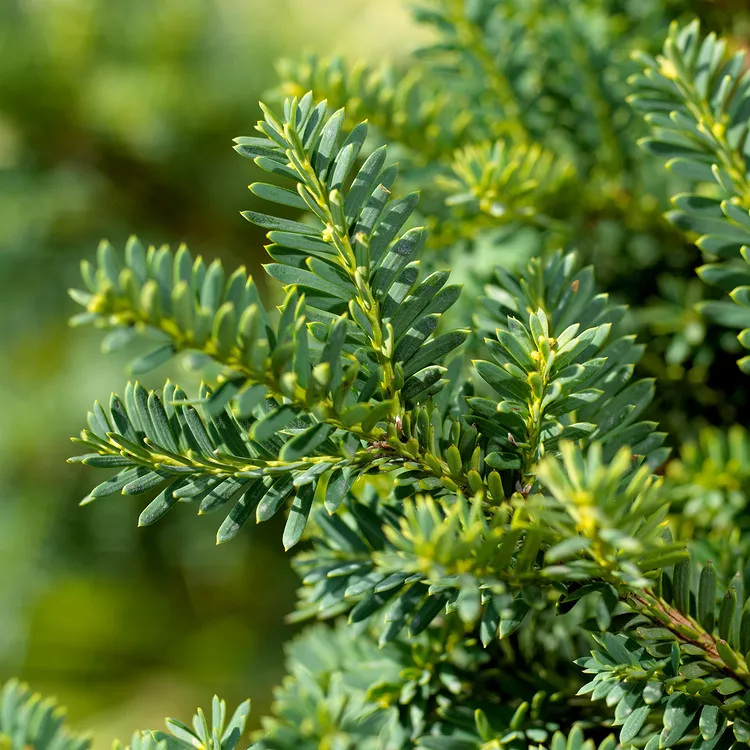
Japanese plum yew (Cephalotaxus harringtonia) is a heat and shade-tolerant, needled evergreen that is an excellent alternative to yew (Taxus spp.) in the southern garden. The new growth emerges light green and matures to a rich dark green color. It can be lightly sheared to maintain shape but is slow-growing and takes a long time to recover from aggressive pruning. It is better to allow this plant to grow naturally and remove stray and awkward growing branches as needed.
Growing Conditions: Part to full shade, well-drained soil with average moisture
Size: 1–10 feet tall, 1–10 feet wide
Zones: 6–9
The bark, leaves, and seeds of Japanese plum yew are toxic to humans when ingested.
Northern Bayberry
Northern bayberry (Myrica pensylvanica) is a mid-sized, semi-evergreen native shrub. It has beautiful grayish-blue fruits from late summer through winter. The fruit is attractive to birds and is covered in a fragrant waxy substance used to make bayberry-scented candles.
This plant tolerates salt spray, full sun, drought, and wet soils. It has a generally upright and open growth habit with light green leaves 1.5–4 inches long. It loses its leaves in cold northern climates in winter, but it makes an excellent informal screening plant in moderate areas. Use it in a native plant garden, as an informal screen, or as a loose hedge. It can be lightly sheared to maintain a tidy appearance.
Growing Conditions: Full sun to part shade, dry to moist acidic soil
Size: 5-12 feet tall and wide
Zones: 3-6, possibly 7
Pyracomeles ‘Juke Box’
Pyracomeles ‘Juke Box’ is a recent plant introduction that is a cross between Pyracantha and Osteomeles. It has glossy evergreen foliage and a compact mounded shape. It is more heat tolerant than boxwood and will grow in Zone 6, but cold weather might damage the foliage. This plant is attractive when left to grow naturally, and it responds well to shearing and hedging. Prune and shear in spring before the new growth becomes woody.
Plant Name: xPyracomeles sp. ‘Juke Box’
Growing Conditions: Full sun to part shade, average soil and water
Size: 3 feet tall, 3 feet wide
Zones: 7–9
Southern Wax Myrtle
Southern wax myrtle (Myrica cerifera) is the evergreen southern cousin of northern bayberry. It has attractive and aromatic olive-green leaves, fragrant blue fruits in winter, and beautiful gray bark. The new growth is golden-yellow, contrasting nicely with other darker evergreen trees and shrubs. It makes an attractive hedge or foundation plant. Left unsheared, it develops a billowing cloud-like form.
‘Don's Dwarf’ is, as the name suggests, a dwarf selection that matures between 2–6 feet tall and wide.
Growing Conditions: Full sun to part shade, average to wet soil
Size: 2–20 feet tall, 2–10 feet wide
Zones: 7–10
Yaupon Holly
Yaupon holly (Ilex vomitoria) is a hardy and resilient option for southern gardeners who struggle to grow boxwood or Japanese holly due to the heat. It has small dark green leaves, dense growth, and responds well to heavy pruning. This fast-growing plant grows as much as 2–3 feet per year that can grow quickly into a dense hedge.
Selections available on the market include ‘Pride of Houston’, a medium to tall female shrub with a heavy fruit set, and ‘Schillings Dwarf’, a dwarf selection that grows only 3–4 feet tall and wide.
Growing Conditions: Full sun to part shade, dry to wet soil
Size: 3–20 feet tall, 3–15 feet wide
Zones: 7–10
The berries of yaupon holly are toxic to humans.
Yew
Yew (Taxus spp. ) is a popular type of evergreen with dark green needles and red berries. Yews can grow very large, but they tolerate heavy pruning and shearing, making them an excellent formal hedging or topiary plant. However, deer love to eat yew so if you struggle with deer, you'll need to treat the plants with a deer repellant or consider another boxwood alternative.
Growing Conditions: Full sun to full shade, well-drained soil, average moisture
Size: 4–40 feet tall, 4–20 feet wide
Zones: 4–8
All parts of yew plants are toxic to humans, dogs, cats, and horses when ingested.
Avoiding Invasive Shrubs
When researching any new plant for your garden, it's important to make a responsible decision. Some common shrubs, such as heavenly bamboo (Nandina domestica, shown above), barberry (Berberis spp.), and Chinese privet (Ligustrum sinense), are commonly sold as evergreen or semi-evergreen shrubs for the home landscape, so they may appear to be good boxwood alternatives. However, these plants can quickly escape from gardens and spread aggressively in many parts of the country.
The USDA National Invasive Species Information Center is a great place to check for plants you should avoid growing in your area. Don’t rely exclusively on retailers when making important decisions for your garden.