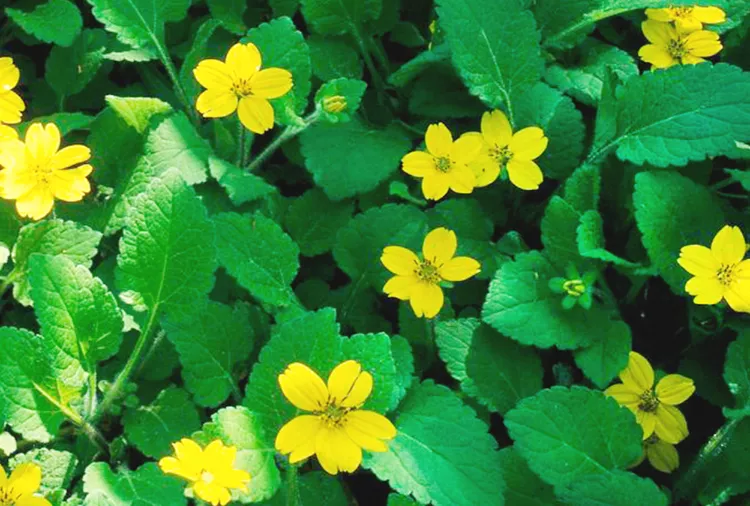
Chrysogonum virginianum goes by several common names, including golden star and green-and-gold, referring to its combination of attractive green foliage and upward-facing star-shape yellow blooms. This low-maintenance native perennial plant forms a spreading mat in sun or shade but does not spread aggressively. Here's what you need to know to grow Chrysogonum virginianum in your own garden.
Chrysogonum virginianum Overview
| Genus Name | Chrysogonum |
| Common Name | Chrysogonum virginianum |
| Additional Common Names | Golden Star, Green-and-Gold, Golden Knee |
| Plant Type | Perennial |
| Light | Part Sun, Sun |
| Height | 3 to 12 inches |
| Width | 12 to 48 inches |
| Flower Color | Yellow |
| Foliage Color | Chartreuse/Gold |
| Season Features | Spring Bloom, Summer Bloom |
| Special Features | Good for Containers, Low Maintenance |
| Zones | 5, 6, 7, 8, 9 |
| Propagation | Division |
| Problem Solvers | Drought Tolerant, Groundcover, Slope/Erosion Control |
Where to Plant Chrysogonum virginianum
Golden star is native to eastern North America, from Pennsylvania to Florida and Louisiana. It's an easy-to-grow, mat-forming groundcover that is adaptable to most light conditions. While it prefers sun-dappled part shade, it will tolerate full sun with consistent moisture and even grows in deep shade (though it may flower less). It prefers a well-draining, slightly acid soil with high organic matter content. Once established, it's drought tolerant.
Chrysogonum is a perfect choice as a groundcover for woodland gardens, naturalized areas, or beneath trees and shrubs. It’s also useful for edging pathways or adding to borders and rock gardens. Considered semi-evergreen, this plant retains most of its leaves except in the coldest parts of its range.
How and When to Plant Chrysogonum virginianum
Plant in the spring in prepared soil, adding organic matter if needed. Place nursery-grown plants in a hole the size of the root ball, spacing the plants 12 to 18 inches apart. Water them well, and mulch them to retain moisture while the plants become established. After the plants spread and fill in, they can be divided every other year in late spring.
Chrysogonum Care Tips
While unassuming in its appearance, golden star is a reliable performer that needs little care. Help your plants get established by keeping the area moist until new roots form and deadheading spent flowers. After they are established, divide the plants as needed in spring to prevent overcrowding; plant these divisions elsewhere or share with a friend.
Light
Chrysogonum virginianum performs best in dappled or light shade. However, it can grow in full sun if moisture is abundant. It will also grow in deep shade but may not bloom as prolifically.
Soil and Water
A well-draining, organically rich soil with a pH of slightly less than 6.0 is ideal, but golden star will adapt to average soil without much trouble. It prefers moderate moisture, but once established, it tolerates dry conditions with ease if it is not growing in full sun. Consistent moisture is necessary to grow it in full sun, but do not overwater—it doesn’t like soggy soil.
Temperature and Humidity
Within its growing range, Chrysogonum virginianum is adaptable to a wide range of temperatures and humidity. Neither cold nor heat seem to faze it. In colder parts of its growing range, it tends to lose some or all of its leaves in winter, while in the warmer regions, it is evergreen.
Fertilizer
Golden star is not a heavy feeder. Adding compost to the soil at planting time usually is sufficient for its needs. Add more compost when plants are divided.
Pruning
Chrysogonum virginianum spreads fairly rapidly, but it’s easy to control the spread if it outgrows your space. Its original clump will increase in size, and it may spread further by seed. Some types also produce stolons that form new plants. If your plants expand beyond the space where you want them, simply remove the extra growth.
Pests and Problems
Golden star has no major pest or disease issues and is attractive to many pollinators, including bees and butterflies. It may occasionally develop powdery mildew, especially if the plants become overcrowded. Remove leaves that turn brown and discard them; then divide the plants the following spring.
How to Propagate Chrysogonum
The easiest way to increase your stand of golden star is to divide the plants in late spring. Dig up large clumps and divide them into sections. If the center appears overcrowded, discard it and replant the vigorous outer sections. If stolons (creeping horizontal runners) developed new plants at their tips, remove the rooted plantlets and replant them wherever you want a low-growing groundcover. You may find seedlings near the base of the mother plant that can be dug and replanted.
Types of Chrysogonum
'Allen Bush'
Chrysogonum virginianum ‘Allen Bush’ is a compact dwarf form that is a very heavy bloomer. The bright yellow flowers grow to 1.5 inches in diameter. In cool summer climates, it blooms from spring to fall. In hot summer climates, it may stop blooming entirely and then start again in the fall. The flowering stems rise above the 3–4 inch foliage mat by about 10 inches. Zones 5–9
'Pierre'
Chrysogonum virginianum ‘Pierre’ grows 6 inches tall with an exceptionally flat mat-forming habit and soft green leaves. This eastern U.S. native is covered with 1-inch-wide, yellow daisy-type blooms over an extended period. In cool weather, it blooms throughout the summer, except for the South. Zones 5–8
'Quinn's Gold'
Chrysogonum virginianum ‘Quinn’s Gold’ bears flowers that emerge bright gold and mature to shades of light yellow and creamy white. All the flower colors may be present simultaneously as it blooms sporadically from April through October in the Eastern states and the South. It seems to thrive on neglect. Zones 5-9
'Eco-Lacquered Spider'
Chrysogonum virginianum var. australe ‘Eco-Lacquered Spider’ isn't a clumping cultivar. Instead, its purple stolons support glossy green leaves that form a spreading evergreen groundcover reaching 4 feet wide in only two years. The 6- to 12-inch-tall plant is covered with small yellow blooms in spring. Zone 5–8
Chrysogonum Companion Plants
Chrysogonum virginianum makes a great addition to mixed native gardens, especially those in part shade, as well as in a woodland garden or at the wood’s edge. It mingles pleasantly with many garden favorites.
Indian Pink
Indian pink (Spigelia marilandica) is an often underappreciated wildflower native to the southeastern United States. Gardeners love it for its predictable show of flowers in late spring every year. The colorful trumpet-shaped blossoms are yellow inside and red outside. These blossoms stand out from across the yard and attract bees, butterflies, and hummingbirds. It is relatively deer- and rabbit-resistant. Zones 5-9
Coral Bells
Coral bells (Heuchera spp.) come in a rainbow of colors, with some varieties grown specifically for their masses of flowers. This low-maintenance perennial is hardy in Zones 3-9 and easily adaptable to ground and container planting. New varieties of coral bells appear on the market nearly every year with improved colors, larger leaves, brighter flowers, and new patterns.
Crested Iris
Crested iris (Iris cristata) is a type of iris native to areas of North America. This beauty is a low-growing, rapidly spreading plant that is only 3-6 inches tall with flower spikes that reach 10 inches tall. It bears blue, white, or purple flowers in spring over tiny clumps of sword-shaped foliage. Zones 3-9
Foamflower
Foamflower (Tiarella spp.) is another popular shade garden plant. While the foliage of this woodland native may not be quite as showy as coral bells, foamflower compensates with a bounty of blossoms. In the spring, the plants are loaded with spires of foamy white flowers that give the perennials their name. The blossoms typically last anywhere from four to six weeks. Zones 3-9
Ferns
Ferns of all types deliver welcome color and texture in shady spots, especially when mixed with flowering plants that similarly thrive in shade. Their hardiness varies by species, but overall, ferns make tough yet beautiful additions to just about any shade garden. Hardiness varies depending on species.