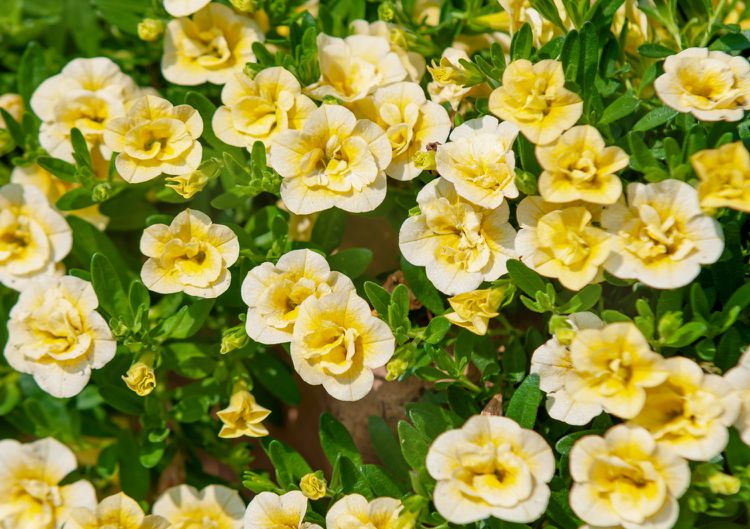
With flowers that look like tiny petunias, calibrachoa (also called Million Bells) grows and blooms at an amazing rate. These extremely vigorous plants make for colorful, cascading accents in containers or hanging baskets, along walkways, and on garden walls. Calibrachoa has only been available in the retail plant world since the early 1990s. That's not long in plant years, especially with how far the plant has come since then. What started as a simple, single-color bloom has transformed into a whole new class of plant that people enjoy adding to their gardens year after year.
Little trumpets of color, calibrachoa flowers create a fanfare day in and day out. Following developments in breeding, calibrachoa blooms come in a rainbow of options, including yellow stars, speckles, veined and segmented petals, and sometimes combinations of all of the above. For extra curb appeal, plant your calibrachoa in a sunny window box.
Much of the work that's gone into calibrachoa breeding has been to make these plants day-neutral, meaning that they bloom all season, no matter how long or short the days are.
Calibrachoa Overview
| Genus Name | Calibrachoa |
| Common Name | Calibrachoa |
| Plant Type | Annual |
| Light | Sun |
| Height | 3 to 9 inches |
| Width | 6 to 24 inches |
| Flower Color | Blue, Orange, Pink, Purple, Red, White, Yellow |
| Foliage Color | Blue/Green, Chartreuse/Gold |
| Season Features | Fall Bloom, Summer Bloom |
| Special Features | Good for Containers |
| Zones | 10, 11, 9 |
| Propagation | Stem Cuttings |
Where to Plant Calibrachoa
If you're looking to quickly fill a container or hanging basket, this plant is up to the task and mixes well with other plants. Tuck it into the front of a border, where it can spill out onto sidewalks or patios. Use calibrachoa to fill gaps in a rock garden with other colorful perennials. It doesn't typically get much taller than 4 inches. Its spread draws attention: Some plants can extend over 2 feet of ground in no time.
How and When to Plant Calibrachoa
Calibrachoa is sensitive to cold temperatures, so make sure the last frost has passed in your area before planting. Dig a hole the same depth and just a bit wider than your nursery pot. Remove the plant from the pot and gently loosen the soil around the roots. Place the plant in the hole and backfill with soil or potting mix and firm around the plant. Water deeply. Plant at least 12 inches apart to allow for growth, and keep the soil consistently moist during the first few weeks after planting.
Calibrachoa Care Tips
Calibrachoa plants bloom all summer long when their needs are met.
Light
Calibrachoas require from 6-8 hours of sun daily for the best blooms. They tolerate partial shade but produce fewer blooms.
Soil and Water
Use an all-purpose potting mix in containers or hanging baskets. Calibrachoas do best in containers with good drainage. When planted in beds outdoors, they benefit from well-draining soil that has been amended with nutrients.
Fertilizer
Calibrachoas are heavy feeders and need regular applications of fertilizer to support their continuous bloom period. Add a slow-release fertilizer to the soil before planting, or apply a water-soluble fertilizer every two weeks.
Since it's such a fast grower, calibrachoa requires a decent amount of food and will let you know if it needs sustenance. Sensitive to low amounts of nitrogen, calibrachoa turns yellow when it needs to be fed. So, if your plants look a little golden, it's time to give them a nice dose of fertilizer.
Innovations
Recently, some interesting work has been done with calibrachoa plants. An example is the creation of the petchoa, a cross between a petunia, a close relative, and the calibrachoa. This hybrid looks a lot like you might expect, considering its parents: a giant flowering plant with a mounded habit—the best of both worlds.
Types of Calibrachoa
Calibrachoa can be treated as an annual in most of the United States, but it is perennial in Zones 9-11.
'Cabaret Hot Pink' Calibrachoa
'Cabaret Hot Pink' Calibrachoa bears multitudes of bright pink flowers on trailing stems to 8 inches.
'Cabaret Purple Glow' Calibrachoa
'Cabaret Purple Glow' Calibrachoa trails to 8 inches and tolerates part shade. It grows 12 inches wide.
'Can-Can Mocha' Calibrachoa
'Can-Can Mocha' Calibrachoa offers creamy flowers with a chocolate-purple throat. It has a mounding-trailing habit and grows 15 inches tall and wide.
'Colorbust Chocolate' Calibrachoa
Calibrachoa 'Colorburst Chocolate' is a compact, mounding selection to 8 inches and offers burgundy blooms blushed with chocolate-brown.
'Million Bells Terra-Cotta' Calibrachoa
'Million Bells Terra-Cotta' Calibrachoa offers orange flowers streaked with shades of red and gold on trailing stems to 8 inches.
'Million Bells Coral' Calibrachoa
'Million Bells Coral' Calibrachoa offers lots of coral-pink flowers on trailing stems to 8 inches.
'MiniFamous Compact Dark Red' Calibrachoa
'MiniFamous Compact Dark Red' Calibrachoa produces rich red flowers on a compact 8-inch trailing plant.
'MiniFamous Double Blue' Calibrachoa
'MiniFamous Double Blue' Calibrachoa shows off fully double velvety-blue flowers on a trailing plant with 10-inch-long stems.
'MiniFamous Double Blush' Calibrachoa
'MiniFamous Double Blush' Calibrachoa bears gorgeous double pink flowers on a vigorous trailing plant with 10-inch-long stems.
'Minifamous Double Pink' Calibrachoa
MiniFamous Double Pink Calibrachoa produces double pink flowers on a plant that trails to 10 inches.
'MiniFamous Double Yellow' Calibrachoa
'MiniFamous Double Yellow' Calibrachoa produces intricate double flowers on a vigorous plant that trails to 10 inches.
'MiniFamous Sun Violet Veins' Calibrachoa
'MiniFamous Sun Violet Veins' Calibrachoa bears soft blue flowers with violet-purple netting on a vigorous plant that trails to 10 inches.
'MiniFamous Tangerine' Calibrachoa
'MiniFamous Tangerine' Calibrachoa offers soft yellow flowers with orange markings on a vigorous plant that trails to 8 inches.
'Superbells Blackberry Punch' Calibrachoa
Blooms of the 'Superbells Blackberry Punch' feature a deep raspberry-red outline with an almost black center.
'Superbells Blue' Calibrachoa
'Superbells Blue' Calibrachoa is a floriferous variety with loads of violet-blue flowers on trailing 8-inch stems.
'Superbells Cherry Star' Calibrachoa
A Calibrachoa hybrid, 'Superbells Cherry Star' was one of the first to produce this bright yellow star pattern in the center. This particular series showcases a cherry-colored backdrop.
'Superbells Dreamsicle' Calibrachoa
'Superbells Dreamsicle' Calibrachoa is a vigorous variety that shows off creamy orange flowers on a plant that trails to 3 feet or more.
'Superbells Lavender' Calibrachoa
'Superbells Lavender 'Calibrachoa bears an abundance of lavender flowers on trailing 36-inch-long stems.
'Superbells Peach' Calibrachoa
'Superbells Peach' Calibrachoa offers salmon-orange blooms with a darker throat. It holds up well to rainy weather and trails to 30 inches.
'Superbells Saffron' Calibrachoa
'Superbells Saffron' Calibrachoa bears yellow flowers with a red-orange throat. It trails to 36 inches.
'Superbells Scarlet' Calibrachoa
'Superbells Scarlet' Calibrachoa bears bold scarlet-red flowers on a vigorous plant that trails to 30 inches.
'Superbells Tequila Sunrise' Calibrachoa
'Superbells Tequila Sunrise' Calibrachoa produces a plethora of orange flowers with yellow streaks. This vigorous variety can trail to 30 inches.
'Superbells Trailing Lilac Mist' Calibrachoa
'Superbells Trailing Lilac Mist' Calibrachoa bears lots of cream flowers with dark blue veins and has better heat- and drought-tolerance than most. It trails to 3 feet.
'Superbells Yellow Chiffon' Calibrachoa
'Superbells Yellow Chiffon' Calibrachoa produces soft yellow flowers on a floriferous plant that trails to 30 inches.
'Superbells Yellow' Calibrachoa
'Superbells Yellow' Calibrachoa features large, clear yellow flowers and a low, trailing habit. It trails to 30 inches.
'Voodoo' Calibrachoa
'Voodoo' Calibrachoa produces plum flowers with yellow streaks and flecks. Each bloom is different. The plant trails to 30 inches or more, making it a good choice for hanging baskets and large mixed container gardens.
Calibrachoa Companion Plants
Angelonia
Angelonia is also called summer snapdragon, and once you get a good look at it, you'll know why. It has salvia-like flower spires that reach 1-2 feet tall, studded with fascinating snapdragon-like flowers with beautiful colorations in purple, white, or pink. It's the perfect plant for adding bright color to hot, sunny spaces. This tough plant blooms all summer long. While its varieties are beautiful, the sweetly scented selections offer a bonus. Most gardeners treat angelonia as an annual, but it's a tough perennial in Zones 9-10. If you have a bright, sunny spot indoors, you can keep it flowering all winter.
Coral Bells
Exciting selections with incredible foliage patterns put coral bells on the map. Once enjoyed mainly for their spires of dainty reddish flowers, coralbells are also grown for the unusual mottling and veining of different-colored leaves. The low clumps of long-stemmed evergreen or semi-evergreen lobed foliage make coralbells fine groundcover plants. They enjoy humus-rich, moisture-retaining soil. Beware of heaving in areas with very cold winters.
Zinnias
Zinnias are vigorous, fast-growing annual flowers that make beautiful additions to the garden. They vary from tall, stately plants suitable for borders to dwarf varieties that work well in containers. The flowers come in a range of colors, including red, pink, yellow, orange, and white. Plant them in full sun and provide consistent moisture.