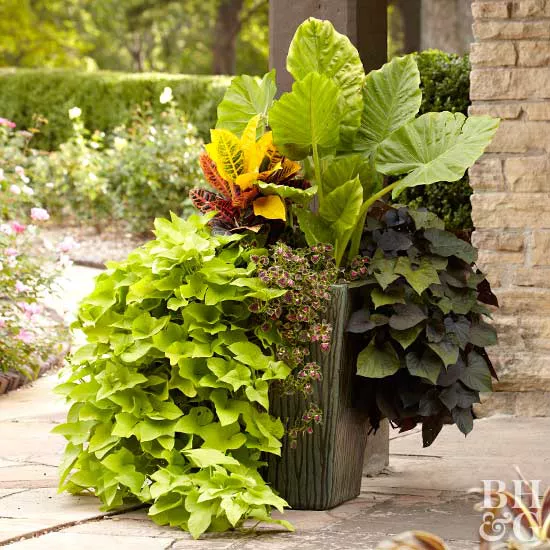
Tropical plants, available in a wide range of colors, shapes, and sizes, are ideal for adding drama to the deck, patio, or balcony. Tropical plants make it easy to create an eye-catching combination in a large container. You can leave them outdoors and treat them like annuals, or if you have lots of light in your home, keep them over winter as houseplants to be used outdoors again next spring.
Design and Maintenance
For a stunning accent, grow one tropical flower per large container, and add colorful annual flowers around the base. To keep ahead of watering chores, hook up a drip irrigation system designed for potted plants, with one drip emitter per pot. The larger the container, the less often you'll need to water. Tropical plants typically prefer soil that is moist, but not overly wet.
How to water without over-watering.
Flowering Maple
Flowering maple (Abutilon selections), named because of their leaf shape, are native to tropical regions of the world. Their bell-shape flowers, in yellow, orange, pink, or red, open wide and dangle slightly from slim stems. Some types have variegated foliage. Abutilons, nicknamed parlor maples, are easy to grow and bloom all spring and summer. Grow them in medium to bright light; for best flowering grow them in bright light at least 4 hours a day. Keep the soil extremely moist but avoid letting the plant stand in water. Size varies; some can grow into trees 15 feet tall and wide.
Angelwing Begonia
Begonias (Begonia selections) are stalwarts among annuals because they are so easy to grow. For a tropical display, look for the large angelwing varieties (Begonia coccinea), named for their elongated leaves that resemble wings. Many come with variegated leaves. Clusters of white, red, or pink flowers dangle from each stem. Begonias grow best in bright but indirect light; too much light can burn the leaves. Keep the soil evenly moist and avoid overwatering.
Bromeliad
Although bromeliads look otherworldly, they are easy to grow. There are many kinds of bromeliads, but the most distinctive feature is a cup-shape rosette of leaves that holds water, which nourishes the plant. Large, colorful bracts (leaves that look like flowers) or flowers may emerge from the center, creating a fantastic display. Most bromeliads are air plants that grow on trees in nature, gathering their moisture from rainfall and humidity. Keep their roots in an orchid bark potting mixture or other soil that drains quickly, and keep them in pots that look a bit too small. They are liable to die if kept in containers that are too large or if they are overwatered. For best flowering, grow them in high light and warm temperatures.
Angel's Trumpet
Angel's trumpet (Brugmansia and Datura selections) are patio stunners. Brugmansia selections offer trumpet-shape white, pink, peach, or yellow blooms that dangle downward. The plant can reach as much as 30 feet tall (but may only reach 6 feet tall in a container over a season). Blooms are fragrant at night when its pollinators are active. Many Datura selections offer trumpet-shape, upward-facing flowers. Outdoors, grow both types in moist, well-drained soil in bright, indirect light. The plants are heavy feeders, so fertilize them regularly in spring and summer with a general-purpose fertilizer. Reduce water and fertilizer during fall and winter months. Beware: All parts are poisonous.
Explore more garden plants with a tropical flair.
Canna
Old-fashioned favorites that are beloved for their bright flowers and dramatic, large leaves, cannas (Canna selections) add vertical interest to a container or an in-ground planting. Look for varieties with burgundy or variegated leaves to add punch even when the plant is not in bloom with red, orange, or yellow flowers. Although some varieties reach 7 feet tall, others are bred to remain as short as 2 feet. Grow them in full sun in moist soil (they're ideal for clay locations). Canna rhizomes may be hardy in the ground in Zones 8-11. In other locations, let the foliage blacken from frost, then lift the rhizomes from the ground and store them in a frost-free area until replanting the following spring.
Hibiscus
Although some types of hibiscus are hardy in northern climates, the most commonly grown are natives of tropical Asia (Hibiscus rosa-sinensis). Glossy, dark green leaves shine behind 6-inch flowers in shades of red, orange, yellow, coral, pink, blue-purple, and white. To keep hibiscus blooming, provide high light. Several hours of direct sun per day is best. Keep the soil evenly moist but not wet. Hibiscus flowers on new wood, so don't prune or you will lose flower buds. To keep the plant more compact and attractive, prune it back in late winter. At the same time, root-prune and repot it in fresh soil. Hibiscus will shed its leaves when conditions change, but will quickly regenerate leaves on old stems.
Jasmine
For a scented treat, grow Arabian jasmine (Jasminum sambac) in your patio containers. The star-shape blooms in yellow or white will perfume the air; some types are especially fragrant at night. Jasmine, which grows as a twining vine up to 15 feet long, needs to be staked on a trellis or arbor. Grow it in full sun or partial shade with protection from hot midday sun. If jasmine is not blooming, the light may be too low. Keep the soil evenly moist during times of growth and flowering; otherwise, allow the soil to dry slightly between waterings.
Mandevilla
When their trumpet-shape, five-petal flowers are blooming, mandevilla (Mandevilla selections) vines lend a graceful look to a patio garden. Train the stems to twine around a support, such as a trellis or arbor. Vines can reach up to 20 feet long in some climates. Flowers appear on new growth, so heavy pruning stimulates new blooms. The flowers grow in pink, rose, red, and white. Contact with the sap of the vines or leaves may cause skin irritation, so wear gloves when handling them. Eating any part may cause a mild stomach upset. Keep the soil evenly moist during the growing season but allow the soil to dry out between waterings during winter. For best flowering, place mandevilla vines in bright but indirect light, or full sun with midday shade.